The seminar, which was designed as a hybrid event, was attended on site by 17 KAAD alumni and scholarship holders and about ten guests from institutions and programs affiliated with KAAD (Universidad Católica de Santa Fe, Stipendienwerk Lateinamerika-Deutschland, Diplomatura Superior de Ecolologia Integral). Numerous alumni and students from various universities in Latin America were digitally connected to the event. Of particular significance was the participation of Ms. Rachel Elfant, representing the „Healing Earth“-program of Loyola University in Chicago (USA). Ms. Elfant also collaborates with with KAAD department head, Dr. Thomas Krüggeler, in the “University Working Group” of the “Laudato Si Action Platform” (Dicastery for Integral Development).
At this point it is important to emphasize that both UCSF and the Provincial Government of Santa Fe provided significant financial support for the event.
The opening lecture was given by Mexican economist and environmental sociologist Enrique Leff, who called for a radical rethinking of economic action and social coexistence. In conclusion, the scientist, who is very well known in Latin America, thanked the participants for the fruitful debate and assured them that he had gained hope from the strong commitment of this group young scientists.
In the roundtable “Ecology & Health: Towards an Eco-Social Way of Life,” the panelists took as their starting point the increasingly common thesis that human health is intimately related to the health of the ecosystems that surround us. Therefore, they discussed questions such as: What challenges does international health care face today in putting a holistic ecological approach into practice? However, great efforts are still needed to translate the content of an integral ecology into political practice.
The third round of discussions, “Ecology & Nutrition: Agriculture, Food and Institutionalization,” brought out clear differences of opinion among the discussants.) and the consequences of industrial agriculture based on monocultures and meat production was undisputed. were clearly evident in the ideas on how to develop sustainable agricultural production in the future. These debates, some of which expressed the differences between university theory and agricultural practice, enriched the content level of the seminar. Several expert alumni and many KAAD-fellows from Brazil, Guatemala and Columbia participated via virtual platforms in all three conversations.
The Heidelberg-based health scientist PD Dr. Olaf Horstick, who has been providing expert support to our Salud Global aumni-group for 6 years, concluded the seminar with his presentation on “Global Health in the Context of Epidemics”. The presentation of historical examples, combined with extensive statistical background data, made the lecture an exciting experience for the audience. Horstick emphasized the dangers posed by epidemics in a globalized world and the special responsibility that the industrialized north of the world has for global health.
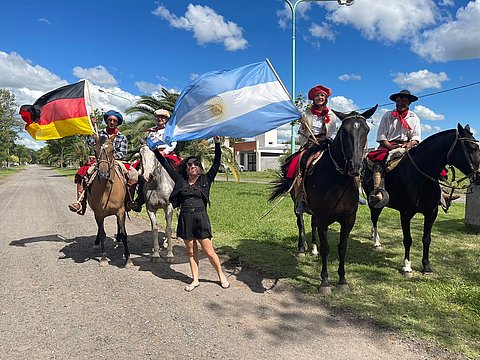
“Gauchos” welcome the group outside Santa Fe
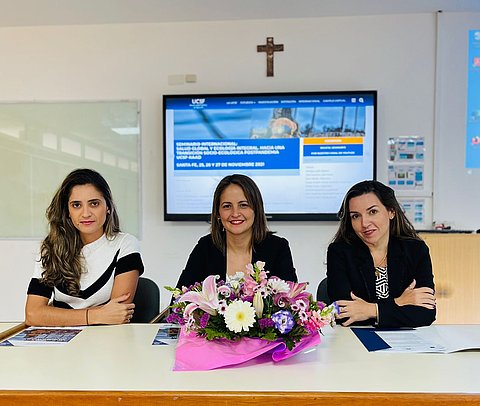
Great supporters of the Salud Global group: Thania Faria, Ana Maria Bonet and Fabiana Faleiros